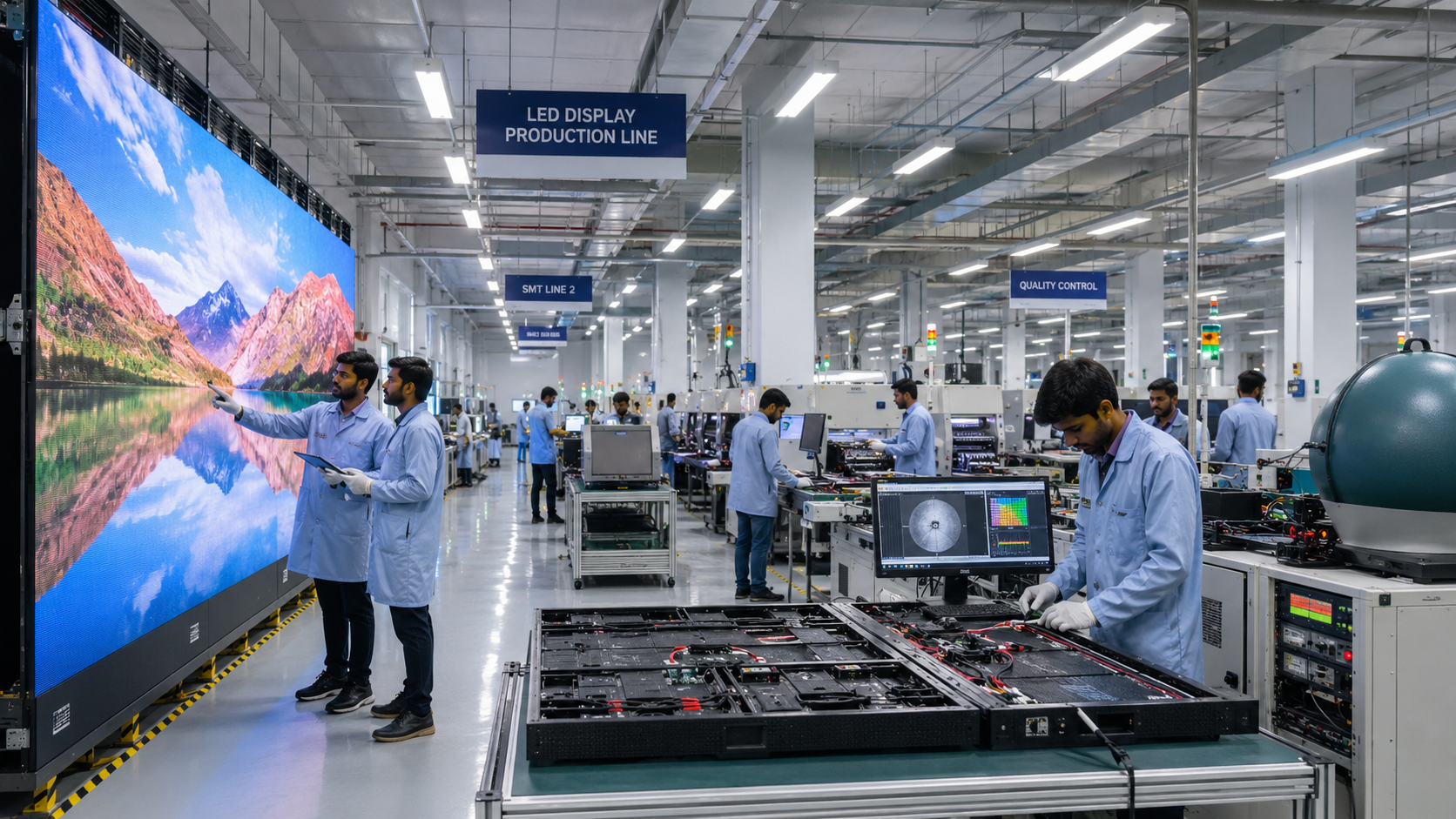
The LED display industry has become increasingly specification-driven. Manufacturers compete through brightness ratings, refresh rates, pixel pitch options, contrast ratios, color gamut claims, and image processing capabilities. Product brochures often position these figures as the primary indicators of display quality, encouraging buyers to compare products based on technical specifications alone.
However, real-world display performance rarely aligns perfectly with marketing comparisons.
Two LED video wall systems may advertise identical brightness levels, similar refresh rates, comparable grayscale performance, and the same pixel pitch. Yet once deployed, the differences often become apparent. One display maintains color uniformity across the entire screen, while another develops visible brightness inconsistencies. One system delivers stable performance over several years, while another experiences increasing maintenance requirements within a relatively short period.
The reason is simple. Specifications describe performance targets. Manufacturing standards determine whether those targets can be achieved repeatedly across every module, every cabinet, and every production batch.
This is why experienced consultants, system integrators, and enterprise buyers increasingly evaluate manufacturing capability before evaluating marketing claims.
Why Manufacturing Standards Form the Foundation of LED Display Quality
Before examining specific manufacturing processes, it is important to understand what manufacturing standards actually mean within LED display production.
Manufacturing standards refer to the engineering controls, quality assurance systems, testing procedures, production protocols, and component qualification processes used throughout manufacturing.
These standards influence every stage of production, from raw material selection to final product inspection.
Manufacturing Quality Begins Long Before Assembly
Many buyers assume quality is determined during final assembly. In reality, quality begins at the component selection stage.
Every LED display relies on multiple electronic components including LED packages, driver ICs, receiving cards, power supplies, PCB assemblies, connectors, and communication systems.
The performance of the finished display can never exceed the quality of the components used to build it.
Manufacturers that implement strict component qualification standards typically achieve higher levels of consistency, reliability, and operational stability than manufacturers that prioritize cost reduction over component quality.
Component Consistency Influences Display Consistency
LED displays operate as integrated systems.
If component characteristics vary significantly from module to module, visual inconsistencies become unavoidable regardless of software calibration or processing capabilities.
This is one reason manufacturing standards remain central to display quality. They establish consistency before the display enters production.
The Manufacturing Processes That Buyers Rarely Evaluate
Most buyers compare visible specifications because they are easy to understand. Manufacturing processes are rarely discussed despite having a greater influence on long-term performance.
LED Binning Controls Color and Brightness Uniformity
No semiconductor manufacturing process produces identical LEDs.
Small variations occur in wavelength, brightness, forward voltage, and chromaticity. Without proper control, these differences create visible inconsistencies across the display surface.
LED binning addresses this challenge by sorting LEDs according to optical and electrical characteristics before production begins.
Tighter binning tolerances generally produce better image uniformity.
SMT Production Determines Assembly Accuracy
Surface Mount Technology (SMT) represents one of the most important stages of LED manufacturing.
During SMT production, LEDs and electronic components are mounted onto printed circuit boards using automated placement systems.
Placement accuracy, solder paste consistency, reflow temperature profiles, and inspection procedures all influence long-term reliability.
A display may appear functional immediately after production, but manufacturing deviations often emerge later as dead pixels, module failures, or signal instability.
Calibration Determines Visual Performance
Many buyers focus on hardware while overlooking calibration.
Even with high-quality components, optical variations remain unavoidable. Calibration compensates for these differences by aligning brightness, color temperature, and grayscale performance across every module.
Without calibration, image uniformity becomes increasingly difficult to maintain, particularly in large-format displays.
Heat Management Influences Every Electronic Component
Heat is one of the primary causes of electronic degradation.
LEDs, driver ICs, power supplies, and receiving cards all generate thermal energy during operation. Excessive heat accelerates component aging and affects long-term stability.
Effective thermal engineering requires more than adding cooling systems. It involves cabinet design, PCB architecture, airflow management, component spacing, and power distribution optimization.
Reliability Testing Identifies Hidden Defects
Manufacturing standards extend beyond production.
Advanced manufacturers perform burn-in testing, environmental testing, vibration testing, and electrical stress testing to identify defects before products reach the market.
These procedures increase manufacturing costs, but they significantly improve long-term reliability.
Why Manufacturing Standards Influence Return on Investment
The true value of an LED display is not determined on the day it is installed. It is determined by how effectively the display performs over several years of operation. Displays manufactured under strict quality standards generally experience fewer component failures, lower maintenance requirements, and reduced operational disruptions.
Large LED installations often require module replacements throughout their operational life.
Manufacturers that maintain strict process control and production traceability can provide replacement modules with greater consistency, preserving visual uniformity across the display.
This becomes increasingly important for long-term installations.
Final Thoughts
The LED display industry often encourages buyers to focus on specifications because specifications are easy to compare. However, specifications represent only the expected outcome of a much larger engineering process.
The real determinant of performance lies within the manufacturing standards that govern component selection, SMT production, calibration, thermal engineering, quality control, and reliability testing.
An LED video wall may be impressive during a product demonstration, but long-term value depends on how effectively it was engineered and manufactured. Ultimately, buyers are not investing in a specification sheet. They are investing in the manufacturing discipline that stands behind it.
Frequently Asked Questions
1. If two LED video walls have the same specifications, how do I determine which one is better?
Specifications provide performance targets, but they do not reveal manufacturing quality. Factors such as component sourcing, calibration processes, SMT assembly standards, and quality control procedures often determine how the display performs over its operational life.
2. Why do some LED video walls develop color differences between panels over time?
Color inconsistency usually results from variations in LED quality, inadequate calibration, component aging, or inconsistent replacement modules.
3. Is a higher brightness rating always an indicator of a better LED video wall?
Not necessarily. Brightness is only one performance parameter. Image uniformity, grayscale reproduction, thermal stability, power efficiency, and brightness retention often have a greater impact on long-term viewing quality than maximum brightness alone.
4. What should I evaluate beyond technical specifications when purchasing an LED video wall?
You should assess manufacturing capability, quality certifications, testing procedures, calibration standards, production infrastructure, component traceability, and after-sales support.
5. Why do experienced buyers ask about manufacturing facilities before discussing specifications?
Manufacturing facilities reveal the production capabilities behind the product. SMT infrastructure, testing laboratories, calibration systems, quality inspection equipment, and production processes often provide a more clear picture of product quality than specifications alone.
No responses yet